Type a sentence, get a gig-ready,
multi-scene preset on your Fractal FM9 in minutes: the signal chain wired, amps
voiced per scene, cabs chosen, scenes named on the footswitches. You read the
exact list of parameter changes, you confirm, and only then do they land on the
hardware over USB MIDI, verified by reading the unit back. A language model
proposes; it never sends. Nothing reaches your amp until you say go.
Free and open source, Apache-2.0 · macOS, Windows and Linux · current release 1.2.2
Live from a connected FM9. Nothing on this page is a mock-up.
331amps, searchable by the real gear they model
2,237cabs, by name and by what the cab actually is
8scenes per preset, named on your footswitches
Every writeverified by reading the unit back
Your AIChatGPT, Gemini, Grok, DeepSeek, Kimi, local, or the Claude CLI
01 · WATCH IT HAPPEN
Watch it happen
Two videos, both real, both on a real FM9.
▶ THE WALKTHROUGH: building a Soldano SLO-100 inspired rig
One sentence, "build me a Soldano SLO-100 inspired rig", and ToneCommand builds
seven complete scenes around one of the most legendary high-gain amps ever made:
crunch and rhythm through high-gain brutality to a singing SLO-style lead. It
plans the signal chain, voices every scene, and shows you exactly what it will
do. You confirm. It builds. Then you play. On a real FM9, scene by scene.
▶ THE PLAYTHROUGH: every scene of a finished preset, played on the FM9
All eight scenes of a drop C metalcore preset, every one of them built by typing
a sentence, played straight through on the hardware. Proof, not screenshots.
Bring your own AI: pick ChatGPT, Gemini, Grok, DeepSeek, Kimi, a subscription
you already pay for, or a model on your own laptop by name in the settings
panel, or use the Claude CLI it finds on its own. ToneCommand translates,
verifies against the real unit, and keeps every write behind your
confirmation (docs/AI-BACKENDS.md).
02 · FEATURES
Features
Everything ToneCommand does, and the words that make it happen. Every prompt
below is a real request you can type.
Build a whole rig from one sentence
A complete multi-scene preset from a single prompt: the signal chain wired,
an amp voiced per scene role, a cab chosen, drives and effects placed, and
the scenes named on your footswitches.
"Build a modern metalcore preset in drop C: a big ambient clean, a tight
chug rhythm, a lead that sings over the mix, and a heavier breakdown."
One tap on + Create drops a blank rig on a free slot (or clears the loaded
buffer on a full unit) so you always have a clean canvas to build on.
Open-ended ask? It asks a couple of quick questions first (era, how many
scenes, how heavy). Specific ask? It just builds.
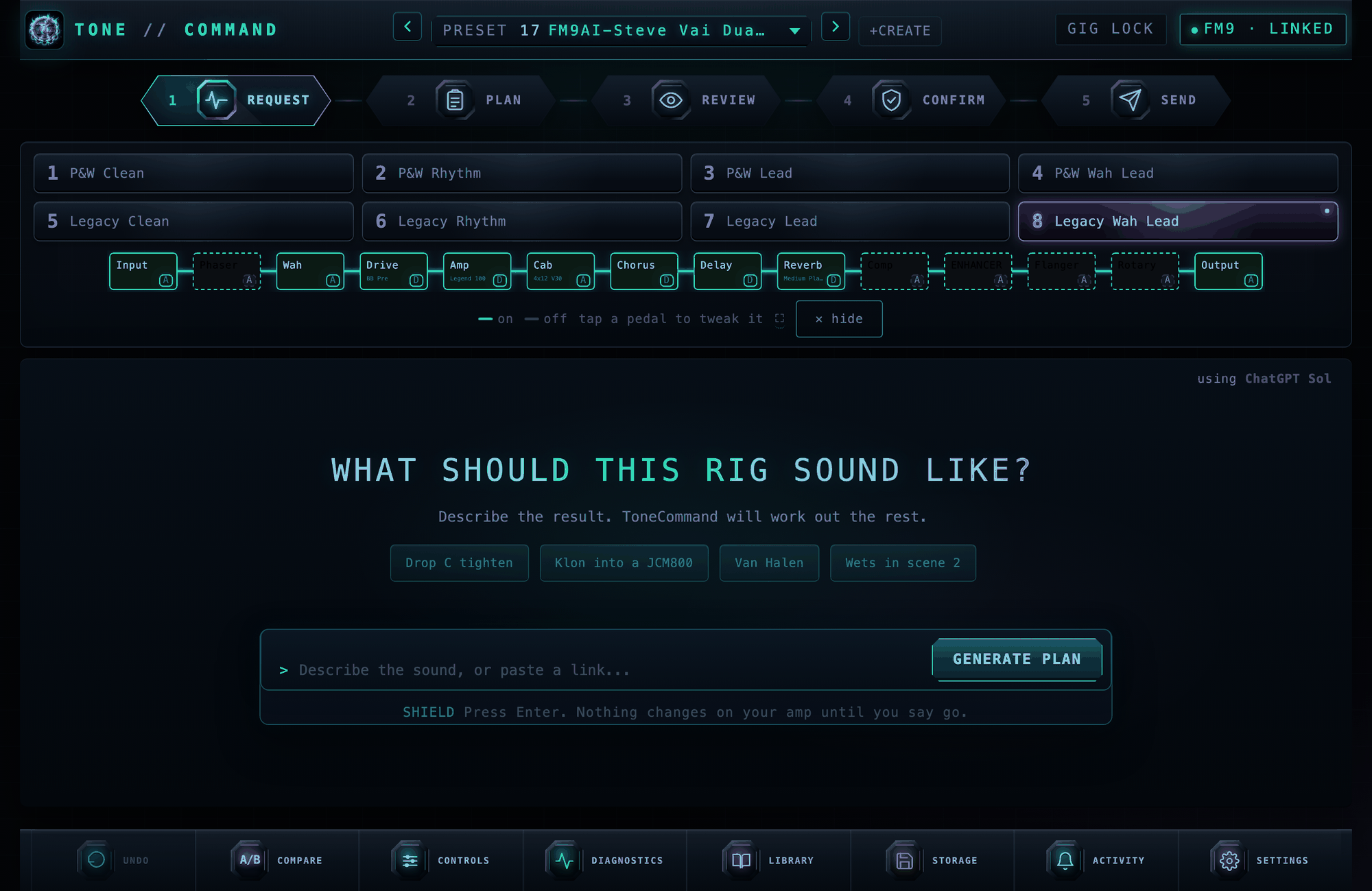
The eight-scene grid fills in live as you talk it through, so you catch a gap
("nothing in scene 8 yet") before it is built.
A tone rulebook rides on every build: cleans come out loud, leads
out-saturate the rhythm, no scene ships silent. That balance was dialed in by
ear on real hardware, so a cold build lands close on the first try.
Build a tone from a video you do not have time to watch
Paste a YouTube link to somebody's rig rundown and get a plan against your own
FM9 without watching it. When the video has captions (nearly all do, whether
the creator published them or YouTube auto-generated them) it reads the whole
transcript and pulls out only the parts that matter in about twenty seconds:
the intro, the sponsor read, the merch plug and every tangent are thrown out,
and a two-hour walkthrough becomes a compact tone spec.
"build the rhythm tone from this rig rundown: youtube.com/watch?v=..."
No captions? It transcribes the audio locally, on your machine, in a few
minutes (up to about ninety minutes of runtime; past that it asks you to paste
the part that matters).
A forum thread or a pasted chat about someone's tone works the same way: drop
in a URL or the text of the conversation and it does the same read-and-extract.
It marks which numbers the source actually stated and which it chose, so a
guess never wears the source's authority. Ballpark to review and tweak, not a
clone, and a build from someone else's video never stores to a slot on its own.
Voice it in plain language
"a Klon into a JCM800 with a greenback 4x12" "tighten the gate for drop C and bump the presence slightly" "make scene 1 a dry crunch rhythm and keep the wets in scene 2"
Pick a cabinet by name, not by scrolling thousands of IRs: "put a 4x12 V30 on
the rhythm channel."
Per-block manual controls with -/+ fine-tune on every slider, a graphic EQ
that looks like one, and 331 amps searchable by the real gear they model.
Borrow tone from the tones you already own
Lift an effect off another preset, aligned scene-for-scene, not just channel
for channel: "make my delay like BT Steve Lukather's."
Compose a preset from parts of several artists' tones:
"clone BT Marco Sfogli into slot 21, take the gain stage from it, the delay
from the Andy Timmons tone, and the reverb from the Periphery one."
Every source is read wire-for-wire first, then the new preset is assembled and
stored once. A better path to a pro tone than guessing parameters from scratch.
Reorder blocks into the right signal-chain order (drive before the amp, delay
before reverb), the path proven intact.
Two expression pedals, by name
"put global volume on Pedal 1 and wah on Pedal 2" "delay mix on Pedal 2 so I can swell into the chorus"
Bind either onboard pedal to any continuous parameter, and unbind it the same
way, all by typing.
Fast, and honest about it
A build lays its whole starter chain in one pass instead of splicing blocks in
one at a time, and verifies a block's parameters in a single read instead of
one-at-a-time. The slow, fragile part is gone.
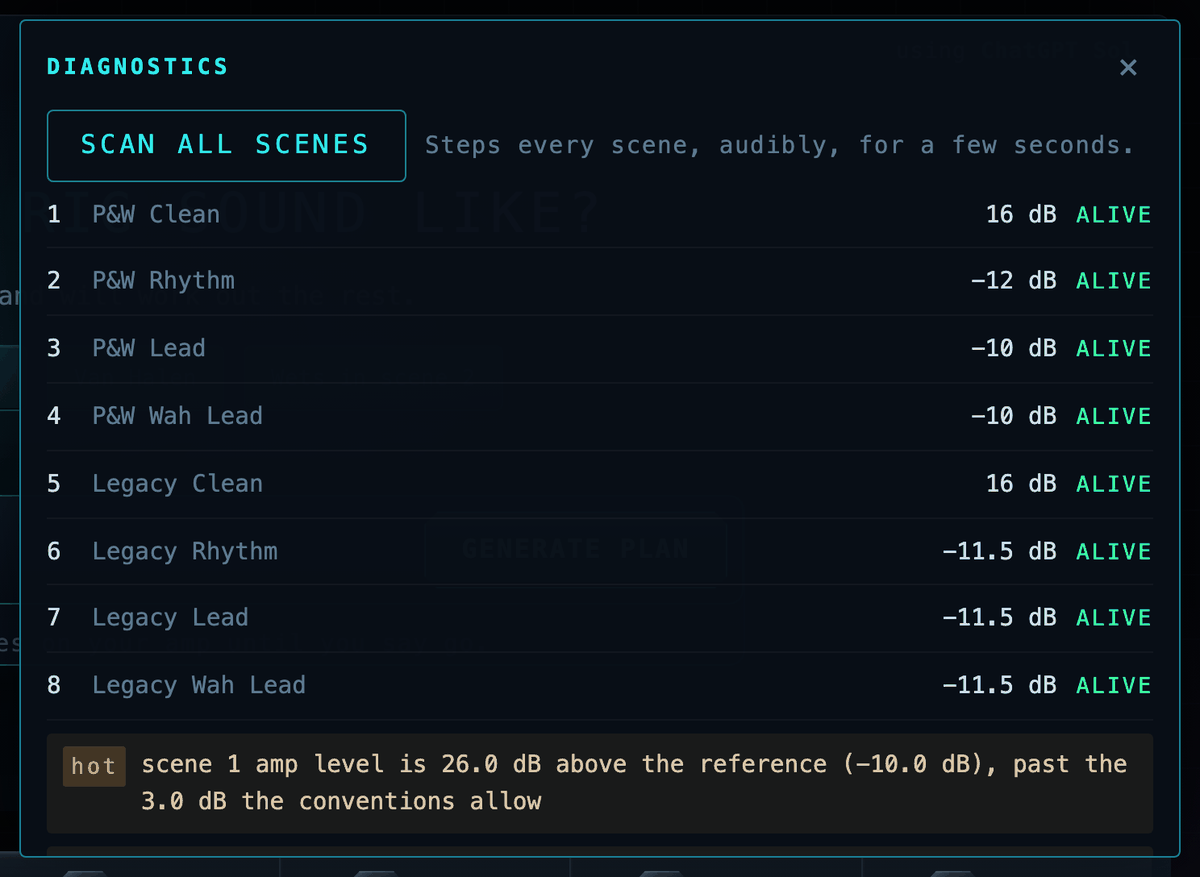
A health scan after every build flags a dead or duplicated scene the
moment it lands. Undo and A/B the FM9 itself does not have.
Install artist presets and cabs from Fractal's Gift of Tone.
Never sends behind your back
Read-back verification on every write, and a signal-path check so a preset is
never silently dead.
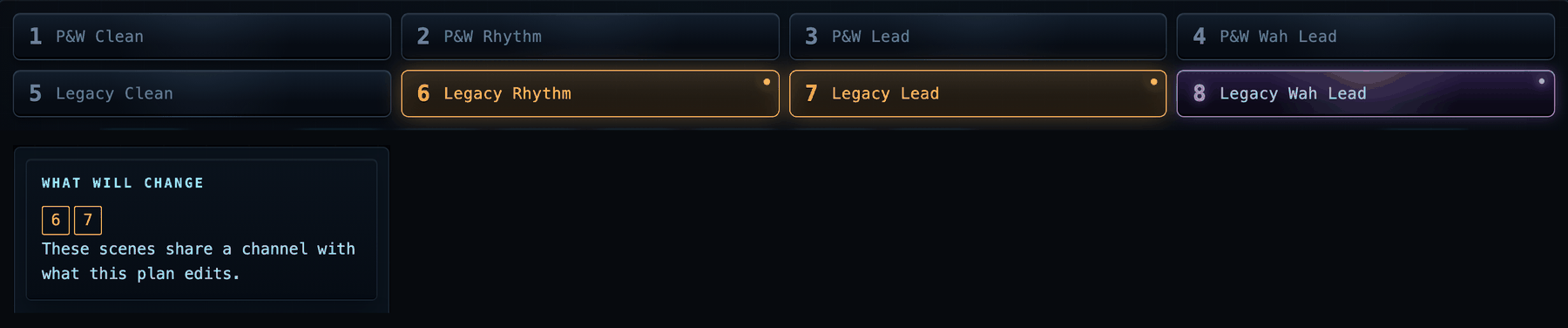
A "what will change" blast-radius preview before anything is sent, including
every other scene a channel-level change would move.
Gig lock: mid-set, only scene changes reach the amp.
Store only to slots you have marked disposable, and only after you confirm.
Bring your own AI: ChatGPT, Gemini, Grok, DeepSeek, Kimi, a subscription
you already pay for, a model on your own laptop, or the Claude CLI it finds on
its own.
03 · HUMANS IN COMMAND
Humans in command
That is not a slogan. It is the constraint every other decision here bends to.
A language model proposes. It never sends. There is no autonomous mode, no
"just do it" flag, and no path from a sentence to your hardware that does not
pass through a human reading the exact list of parameter changes first.
The tool refuses more than it does: it refuses to guess a value it cannot
ground, to name gear it has not verified, to claim a pedal sweep works when
only your foot can prove it, and to store to any preset slot you have not
explicitly marked disposable. And before anything is sent, it shows the blast
radius: FM9 parameters live on the channel, not the scene, so every other
scene a change would quietly move lights up amber and says WILL CHANGE, while
there is still time to not do it.
Every verification in this project ends the same way:
ears: pending, always.
A machine reading a wire can prove the signal is alive, the levels are sane
and the write landed. It cannot tell you the tone is good. That judgement was
never ours to take, and nothing here will pretend otherwise.
04 · WHAT YOU CAN SAY
What you can say
Every line here is a real request the planner turns into concrete, verified
parameter changes, shown to you before anything is sent.
Build a rig
"build a modern metalcore rig in drop C: big ambient clean, tight chug rhythm, a lead that sings over the mix, and a heavier breakdown"
"an 80s hard-rock tribute: big loud chorus cleans, a boosted JCM800 crunch, and a soaring lead"
"give me a Van Halen Balance era tone with the flanger on the expression pedal"
Voice and tweak
"a Klon into a JCM800 with a greenback 4x12"
"tighten the gate for drop C and bump the presence slightly"
"make scene 1 a dry crunch rhythm and keep the wets in scene 2"
"put a 4x12 Recto V30 on the rhythm channel"
Build from a video or a conversation
"build the lead tone from this rig rundown: https://youtube.com/watch?v=..."
"here is a forum thread about a worship rig, build me scene 1 from it: "
paste a whole chat about someone's tone and say "make this on my FM9"
Borrow from artists you own
"take the gain stage from BT Marco Sfogli and the delay from the Andy Timmons tone"
"make my delay like BT Steve Lukather's, matched per scene"
"clone the Periphery Misha preset into slot 22, but pull the reverb from the Majesty one"
Put it under your feet
"put global volume on Pedal 1 and wah on Pedal 2"
"delay and reverb mix on Pedal 2 so I can swell into the chorus"
"add a subtle octave-down layer like a POG under the lead"
05 · THE INTERFACE
The interface
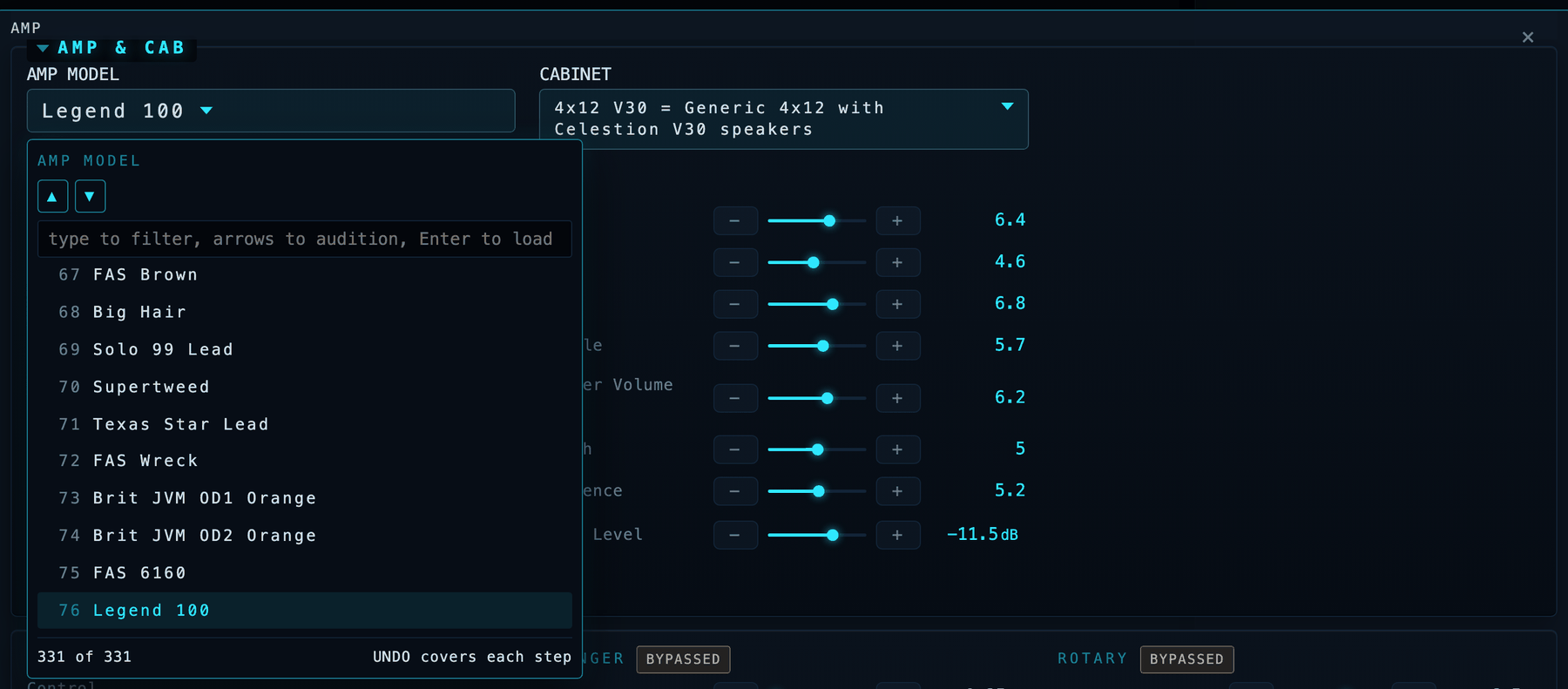
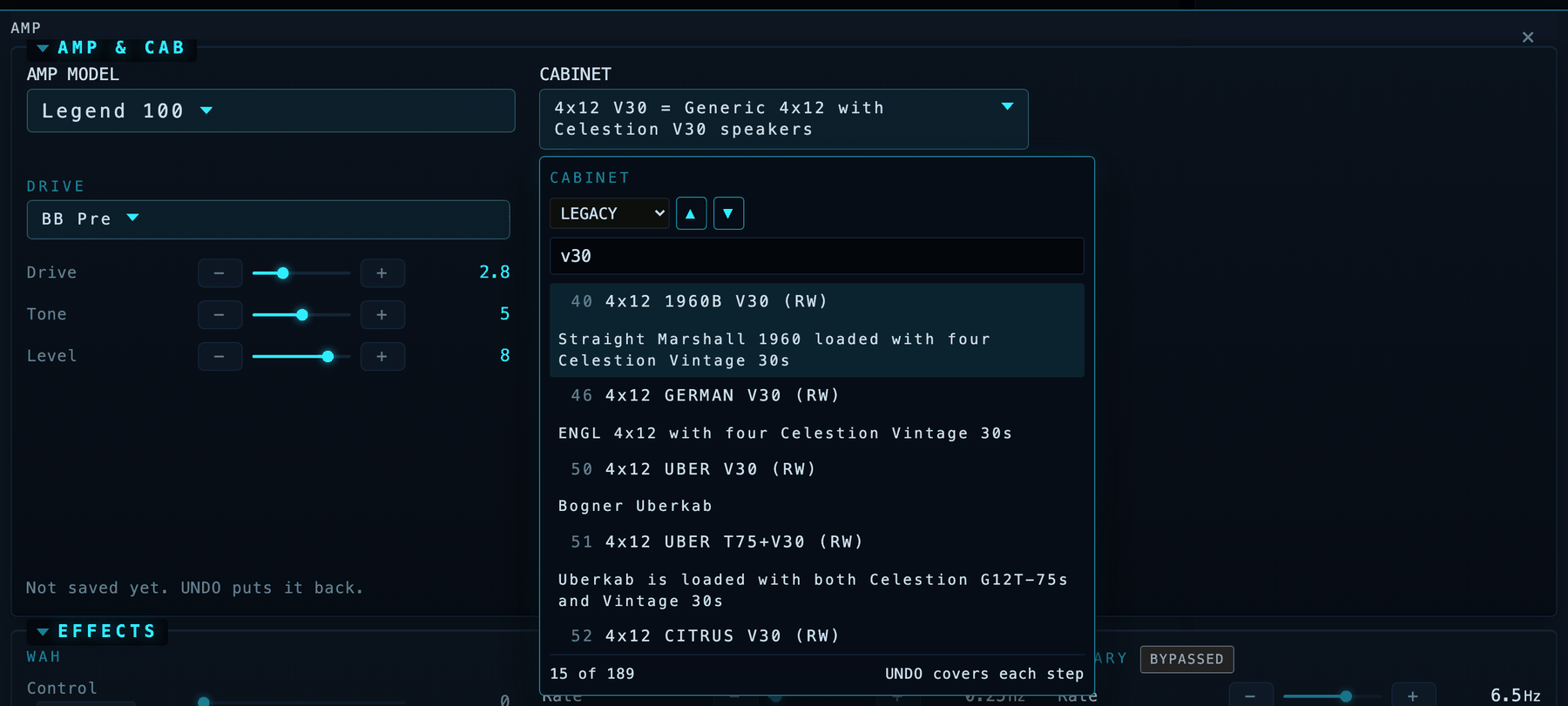
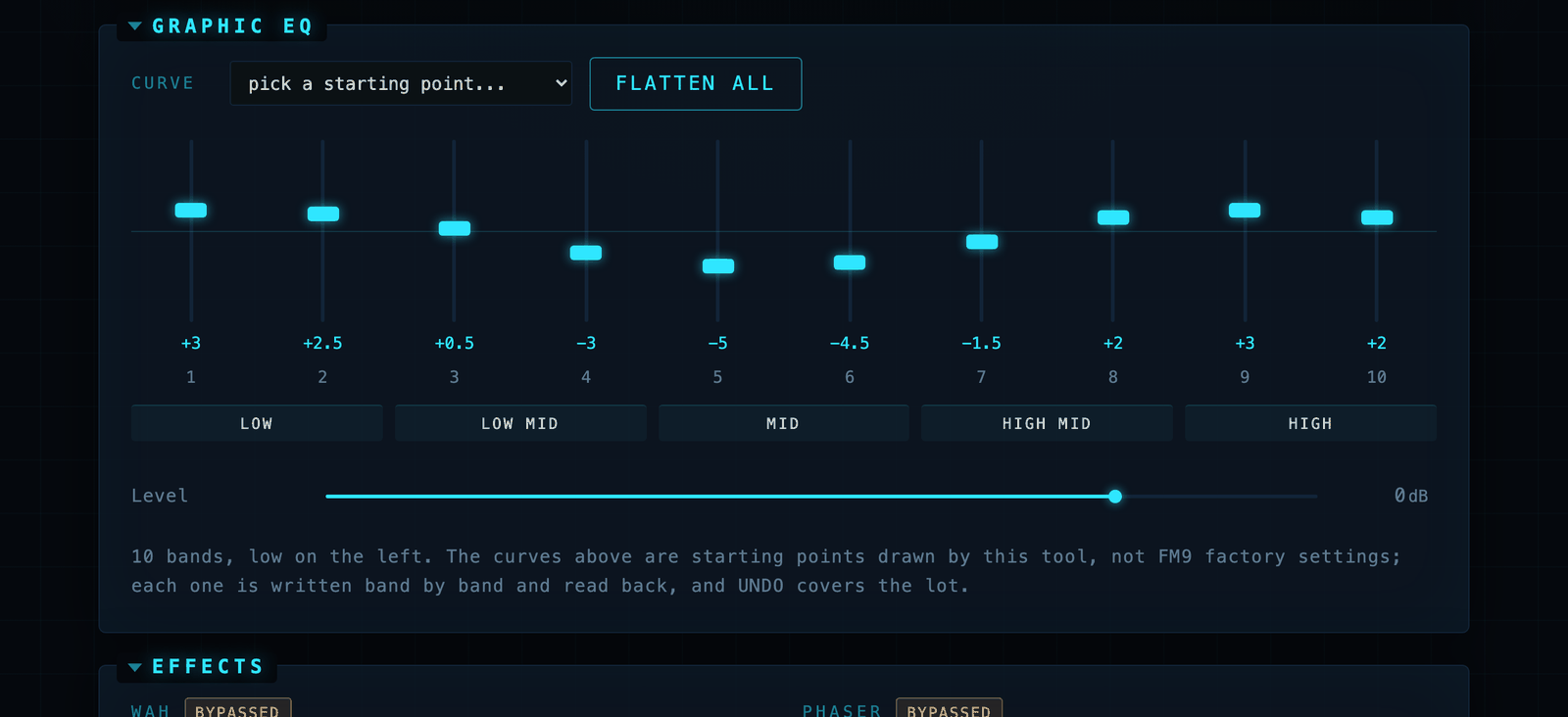
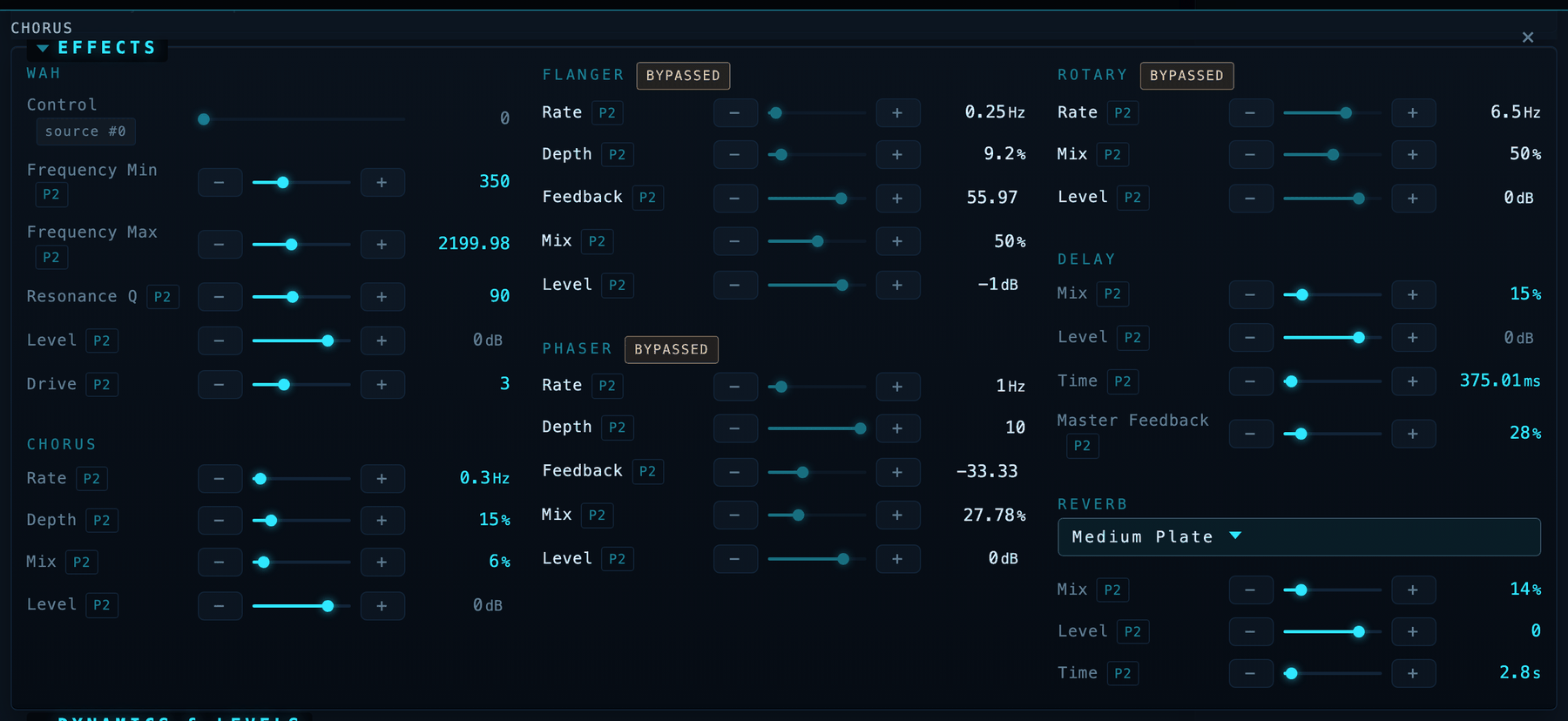
Auditioning amp models: a filtered list stepped with the arrow keysAuditioning cabinets: 1024 entries in one bank, filtered as you typeThe graphic EQ: ten vertical faders over a range strip, with a curve picker and FLATTEN ALLBypassed blocks badged, a modifier-driven parameter naming its source, and P2 buttons on every bindable rowThree scenes lit amber with WILL CHANGE badges, beside the one you are standing inA preset health scan: every scene alive, levels listed, nothing flagged
Everything above is live from a connected FM9; nothing on this page is a
mock-up. The full tour is in docs/INTERFACE.md. The
short version:
The routing grid is your actual routing grid, cables and all, with the
live path lit. Click a block to bypass it, click its letter to change
channel.
Audition amps and cabs by typing, not by turning a knob through 1024
entries. 331 amps and 2,237 cabs, searchable by what the gear really is.
A graphic EQ that looks like one: faders standing up, seven starting
curves, one click back to flat.
Honest panels: bypassed blocks are badged, pedal-driven parameters name
what drives them, and "verified" is never said about a change you cannot
hear.
Blast radius before every send, a health scan that finds dead and
duplicated scenes, undo and A/B the FM9 itself does not have, and
saving with the safety catch on: only to slots you listed, never by
surprise.
06 · HOW IT WORKS
How it works
flowchart LR
    U["Your words"] --> P["Planner<br/>your AI + facts-only<br/>grounding sidecars"]
    P --> V["Safety layer<br/>validation, confirmation,<br/>preset-pinned plans,<br/>store whitelist"]
    V -- "approved plan" --> A["Device adapter<br/>contract"]
    A --> D["FM9 device layer<br/>SysEx over USB MIDI"]
    A --> S["Simulator<br/>models the real quirks"]
    D -- "read-back verify" --> V
The planner never touches the wire. It emits a plan in a closed action
vocabulary; the safety layer validates every action against grounded catalogs
(all 331 amps, 86 drives and 2,235 cab IRs mapped to the real gear they
capture, citations and all), pins the plan to the preset it was computed for,
and requires your confirmation. Only then does the device layer transmit, and
every write is verified by reading the unit back. The simulator sits behind
the same adapter contract, so the whole test suite runs without an FM9
attached (ARCHITECTURE.md).
Building it meant decoding parts of the FM9 editor protocol nobody had
written down. Those findings are free to any Fractal tool builder in
docs/PROTOCOL-CONTRIBUTIONS.md, and the
community work this stands on is credited in
docs/CREDITS.md.
07 · SAFETY
Safety
Rule zero: this tool can never brick a device. It touches only user data,
every operation is recoverable by a power cycle and preset reselect, and the
transport layer refuses to send any message type outside its decoded,
verified surface: firmware and bootloader operations are structurally
unreachable, on every device, forever.
Edit-buffer by default. Changes go where front-panel knob turns go;
re-selecting the preset discards everything.
Confirm before send, and plans are pinned to the preset they were
computed against.
Store is disabled until YOU enable it, via
TONECOMMAND_STORE_SLOTS=133-148 (wire numbers; the editor shows 134-149).
Nobody but you knows what lives in your banks, so there is no default.
Never touches firmware, system settings, or global setup.
Back up first anyway. Run a full Fractal-Bot backup before using any
third-party MIDI tool, this one included.
08 · INSTALL
Install
macOS, Windows and Linux are all supported. Pick yours below. Drivers and
troubleshooting for each are in docs/SETUP.md.
macOS (tested on Apple Silicon, Python 3.12, FM9 firmware 11.00 / 12.00):
Never used a terminal before? Follow
the step-by-step Windows guide instead. It assumes
nothing, needs no git, and covers what to do when something goes wrong.
Linux (untested, expected to work; the MIDI library builds against ALSA, so
install its headers first):
A signed-in Claude Code CLI is found on its own; any other AI is a chip in
the gear menu (docs/AI-BACKENDS.md). To build tones
from YouTube videos, add pip install -e ".[video]" and
brew install ffmpeg (a system dependency; pip cannot install it); details,
testing and FM9-Edit coexistence notes are in docs/SETUP.md.